Every mile, every gallon, every jurisdiction. One ledger you can file from.
IFTA takes the GPS, odometer and fuel purchases your fleet already generates, across every ELD, every card network and every yard pump, and turns them into one record per truck, per jurisdiction, per day: miles, taxable gallons and estimated tax, with the evidence attached to every number.
The tax math is the easy part. The stitching is the product.
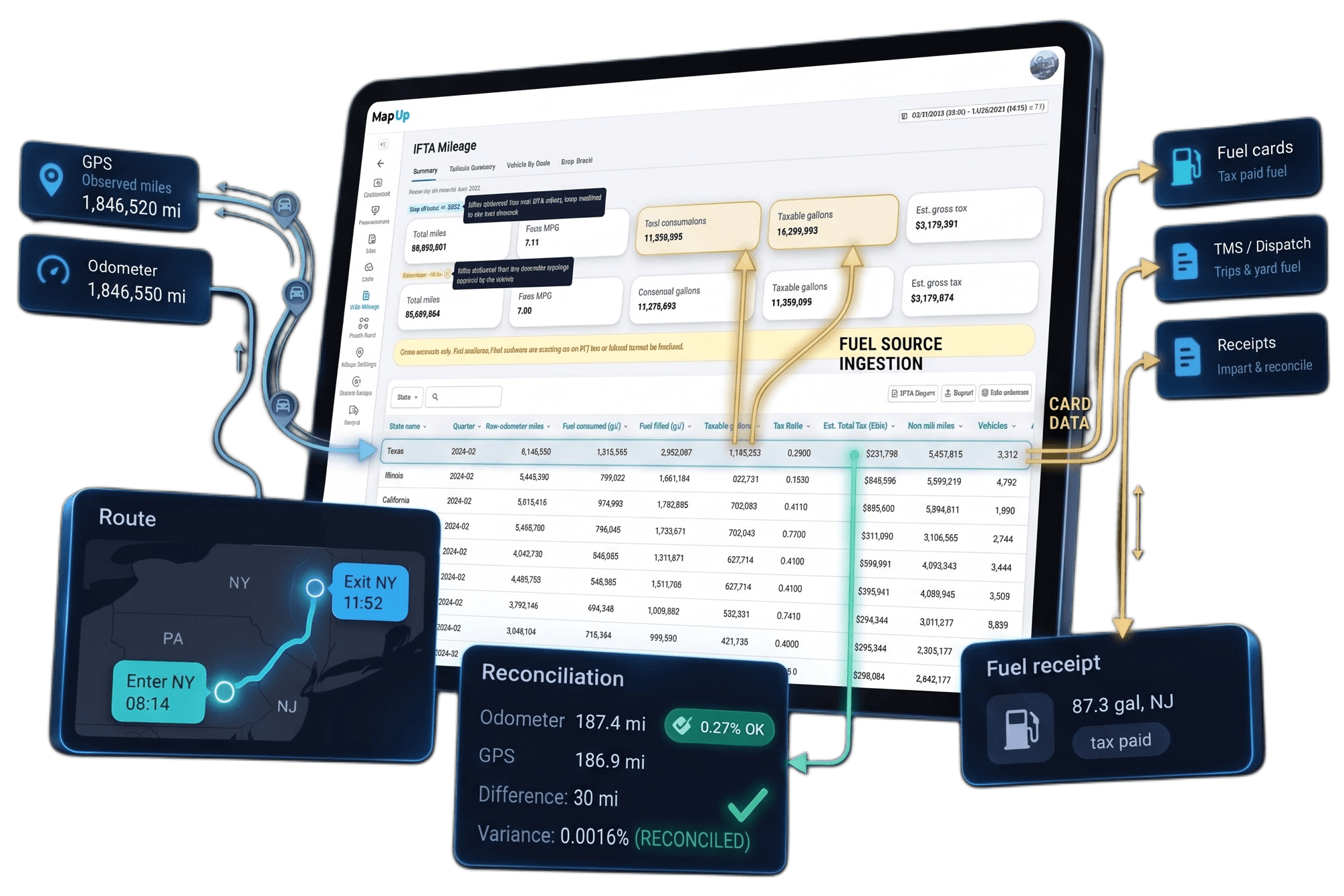
Map-matched GPS and odometer miles side by side, per truck, per state, per day.
Card networks, yard pumps and file imports in one transaction model, tax-paid status on each.
GPS points, border crossings, odometer readings and receipts behind each jurisdiction figure.
Why the quarterly return still takes a week
An IFTA return needs two numbers per jurisdiction: miles traveled and gallons purchased. Neither lives anywhere in one piece.
A fleet is never on one ELD
Some trucks on one provider, some on another, an acquisition brings a third, a migration runs two in parallel. Each vendor's IFTA report covers its slice. The return covers the fleet.
Fuel is worse
Two card networks, a fuel island at the yard that no card network sees, the occasional cash receipt. Tax-paid gallons are your credits. Missing fuel means overpaying; inconsistent fuel means audit questions.
The truck has a different name in every system
Unit 4127 in the ELD, 00412-7 on the fuel card, TRK_4127A in the TMS. Miles from one system and gallons from another have to land on the same vehicle, every day.
Auditors do not take GPS on faith
Miles must reconcile to odometer readings, and the records behind the return must still exist four years later. Most ELDs keep location history for months, not years.
This is the pattern at a carrier we work with: several thousand trucks across multiple operating companies, two ELD providers, two fuel card networks, on-premise fuel and a weekly settlement cycle for owner-operators. Every system held a piece of the fuel tax picture. None of them held the report.
One record per truck, per jurisdiction, per day.
The atomic unit of fuel tax. Daily records for monitoring, weekly rollups for settlement, quarterly rollups for filing. Where a jurisdiction needs a split, the split is in the record.
Miles come from GPS, reconstructed to the route the truck actually drove and checked against the odometer. Gallons come from every fuel source the fleet has. Identity mapping puts both on the same truck.
- ✓ 218 GPS points, entry and exit coordinates
- ✓ Odometer at entry and at exit
- ✓ Toll road match from the toll engine
- ✓ Fuel receipt reference for the day's purchase
Two mileage bases, compared instead of trusted.
Every jurisdiction segment carries the odometer delta and the GPS-reconstructed miles. The difference between them decides how much the number can be trusted, and a record that cannot be trusted is held, not absorbed.
ECM odometer and GPS agree. Odometer miles are used. High confidence.
Minor variance. Odometer miles are used and the segment is logged for review.
Significant variance. GPS miles are used as the fallback and the segment is marked as such.
The record is withheld from the rollup until someone looks at it. A clean-looking report built on quiet assumptions is what fails an audit.
Exceptions are found and held.
Missing fuel for a truck that clearly moved. A GPS gap that looks like a tunnel on one route and a dead device on another. An odometer delta that disagrees with the reconstructed route. A border crossing that had to be inferred. Each is flagged on the record and listed in the exception queue with the reason.
When fuel purchase data is missing altogether, the dashboard says so and labels the tax figure a gross estimate. It does not pretend the net is final.
IFTA is only the first ledger.
Five states run mileage-based programs alongside IFTA, each with its own base, rate table and filing calendar, fed by the same movement data. IFTA computes them on their own ledgers from the same miles, and keeps the rate tables current.
Highway use tax excludes toll-paid Thruway miles; IFTA includes them. New York travel is carried as an IFTA total and split into Thruway and non-Thruway records for HUT and settlement.
Oregon is an IFTA member but taxes heavy vehicles by weight and mile on its own ledger. Oregon records are kept out of the fuel tax totals and reported for weight-mile on their own.
Weight distance tax on vehicles over 59,999 lbs. Kentucky miles stay in the IFTA totals and are flagged for KYU on a flat per-mile rate.
Weight distance tax on vehicles over 26,000 lbs, rate by declared weight tier. New Mexico miles stay in IFTA and are reported for WDT alongside.
Highway use fee on combination vehicles of 26,000 lbs and over, rate by weight bracket. Connecticut miles stay in IFTA and are reported for HUF alongside.
Rates change. IFTA republishes jurisdiction fuel tax rates every quarter. Filing calendars change. When a state changes a rate or a frequency, that is our update to ship, not yours.
Daily numbers firm up. Weekly numbers close for settlement. Quarterly numbers close for filing.
ELDs store and forward. Late-arriving data is a fact of life, so records are finalized on a three-day rolling window and marked incomplete until then. The rollups are built for the way fleets actually work.
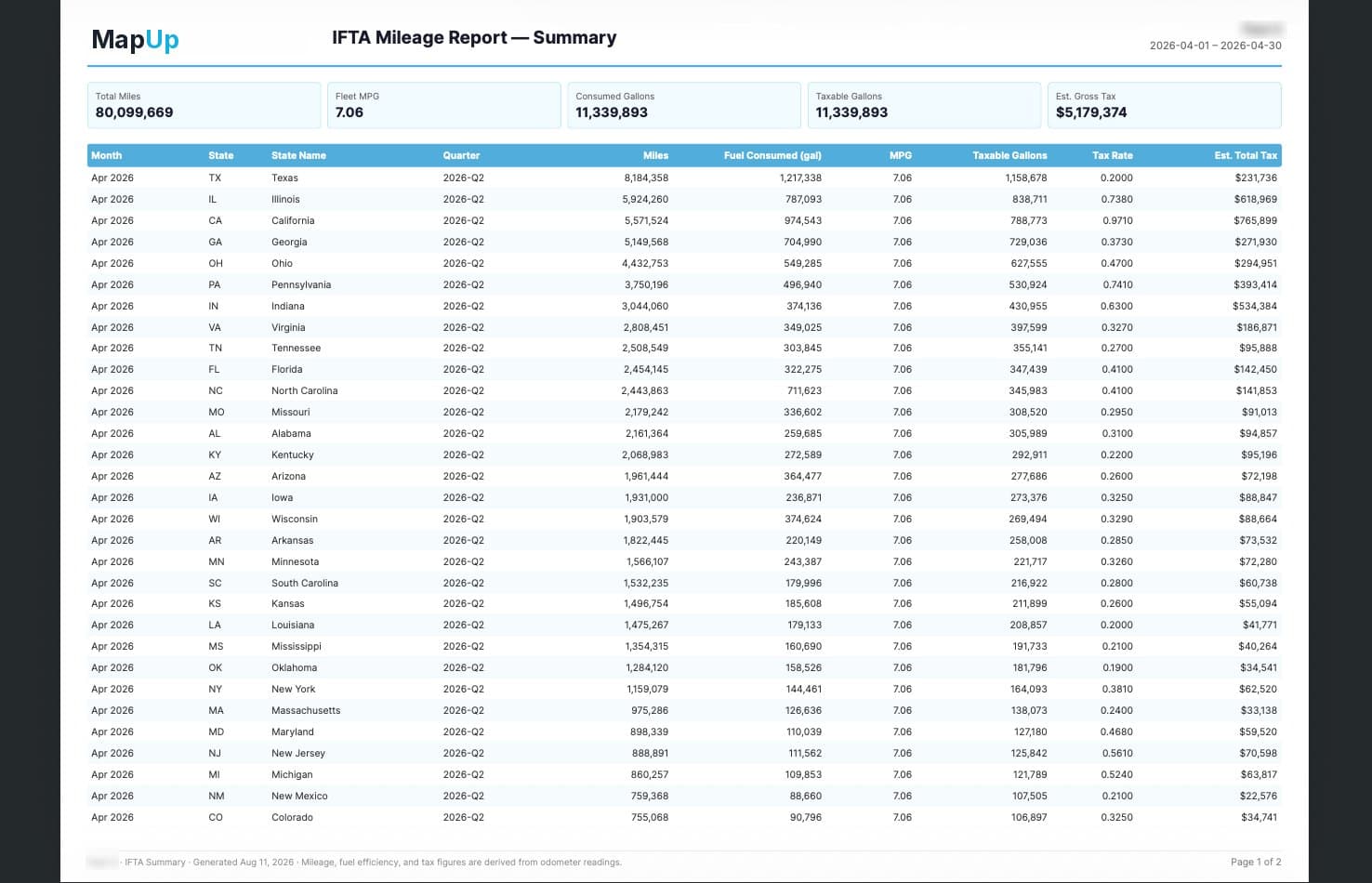
The IFTA Mileage Report, generated from the reconciled ledger: every jurisdiction the fleet touched, with miles, gallons, rate and estimated tax per state. Demo fleet data.
Summary, Vehicle Summary, Vehicle By State and Daily Detail. Both mileage bases on the summary cards, state rows with toll and non-toll miles, filters, column picker, and drill-down from state to vehicle to day.
The state-by-state IFTA Mileage Report as PDF, and CSV or Excel exports of any view, for your filing agent or your own workbook.
Weekly rollup per truck per jurisdiction with fleet MPG applied, for owner-operator fuel tax and fuel credit settlement. Quarterly rollup with net tax gallons per jurisdiction, for the return.
You or your filing agent submit the return to your base jurisdiction. IFTA provides the jurisdiction mileage, taxable gallons, estimated tax and the supporting evidence.
The quarterly filing is the visible deadline. The audit is the one that matters.
IFTA generally requires carriers to keep the records behind a return for four years. Federal hours-of-service rules only require ELD records for six months, and location history varies by provider. A fleet cannot assume the device that generated its proof will still hold it when the audit letter arrives.
MapUp retains the supporting records and the raw GPS behind your reports for the retention period. When an auditor asks how you know a truck was in Indiana on a given day, the answer is the GPS trail, the reconstructed route, the odometer delta and the fuel receipt, attached to the number on the return.
The return is the summary. The evidence is the product.
When an audit names a quarter and a set of trucks, the response package is assembled from these, not rebuilt from exports.
Neutral across every system you already run.
We do not care which ELD, which card network, which TMS. The same telematics connection that powers the toll and fuel products feeds IFTA. Nothing new for drivers or the back office to key in.
GPS and odometer from every ELD in the fleet, one connection per provider




Vehicle identity resolution. Movement and fuel normalization. Jurisdiction classification. Exceptions held. Evidence attached.
Dashboard · API · CSV, Excel and PDF
Card network feeds under your authorization, on-premise pump exports, CSV and API imports, manual entries



An API your settlement system can call on its own schedule.
Per-truck, per-jurisdiction, per-day mileage and fuel records, weekly and quarterly rollups, the vehicle master with every external ID, fuel purchase import, special tax summaries, exceptions and audit evidence. Same x-api-key convention as every MapUp API.
GET /ifta/v1/daily
  ?truck_id=fleet1-truck42
  &date=2026-05-12
x-api-key: YOUR_API_KEY
Fleet-wide, weekly and quarterly variants take a date, a Monday or a quarter instead. Records inside the three-day window come back as 202 with data_complete: false.
Fields align with what settlement teams already consume from ELD trip APIs, with reconciliation, toll road attribution and special jurisdiction flags added on top. Where files are the right interim answer, exports do the same job.
Reconciliation first. Production second.
No fleet should switch fuel tax systems on trust. The numbers feed tax filings and, for many carriers, weekly driver settlement. So we start with six to twelve months of your history: GPS, odometers, fuel transactions for a representative set of trucks. We run it through the engine, put our output next to what you actually filed, jurisdiction by jurisdiction, and explain every difference before anything goes live.
Differences will exist. That is the point of the exercise. "The old process estimated this segment" is an answer. "We switched vendors" is not.
Put IFTA to work.
Everything your fuel tax team, your settlement team and your developers need, by reader.
Connect, enable, reconcile, go live
Unit list and identifiers, telematics and fuel connections, the reconciliation pilot, the weekly and quarterly cadence, troubleshooting.
Fuel tax manager guide
The dashboard views, reading the two bases, working the exception queue, special taxes, month close, quarter close, answering an audit.
API documentation
Endpoints, schemas, the sample response, special tax fields, rollups, imports, errors and the three-day window.
FAQ
Grouped by who is asking: fuel tax managers, settlement teams, IT and integrations, developers, audit, support.
What Customers Are Saying
Every partnership unlocks a new story of efficiency, and savings. Explore what our customers are saying.